
 91 -11 - 2336 3390
  director@caritasindia.org
 A help desk at Delhi labour chowks is fixing India’s migrant welfare gap
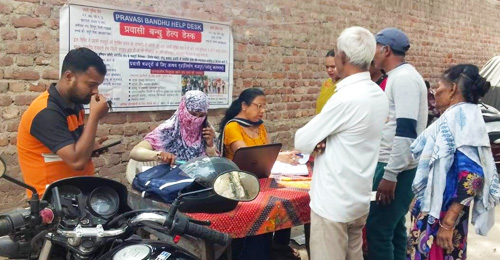
At a crowded labour chowk in Rohini, where men gather at dawn hoping for a day’s work, a small desk cut through the chaos with unusual purpose. No loud announcements. No elaborate setup. Just a few facilitators, a stack of forms, and time to listen.
By the end of the day on 24 March 2026, ninety-five workers had stopped by. This help desk was set up under the Pravasi Bandhu programme, an initiative designed to strengthen the safety and dignity of migrant workers by promoting safe migration practices at both source and destination. Supported by Misereor, the programme pushes a simple but powerful idea: access to protection is a right, not a privilege.
On the ground, that right often collapses under paperwork, lack of awareness, and digital barriers. The intervention at Rohini flips that equation. Eighteen workers were registered for Building and Other Construction Workers (BOCW) cards. Five enrolled for ABHA, India’s digital health ID. Three were referred for ration card updates after server failures blocked online access. Numbers, on the surface. But behind each one is a worker stepping into a system that had long excluded them.
The BOCW registration alone can be life-altering. It opens the door to maternity benefits of ₹30,000, education support that ranges from basic schooling to ₹1.2 lakh annually for professional courses, medical assistance during hospitalisation, and financial aid for marriages. It also provides long-term security of ₹3 lakh for housing support, pensions after the age of 60, disability assistance, and compensation in case of death or accident.
Yet most construction workers standing at labour chowks have never heard of it.
The ABHA card, introduced under the Ayushman Bharat framework, promises a digital health identity, one that stores medical records, enables faster hospital admissions, and reduces the need for physical documents. For migrant workers who move frequently and lose access to paper records, this can mean continuity of care. But adoption remains low, largely due to a lack of awareness and digital access.
Then there are the basics. Ration cards that ensure food security. Shelter homes that offer temporary relief to newly arrived migrants. Legal aid and counselling support for those caught in exploitative work arrangements.
These are not new schemes. They exist. They are funded. They are meant to reach precisely the people standing at these chowks. What is missing is the bridge.
The Pravasi Bandhu programme is filling this gap with clarity. It combines legal aid, awareness campaigns, and on-ground counselling to equip workers with information and agency. It does not wait for workers to navigate complex systems. It meets them where they are.
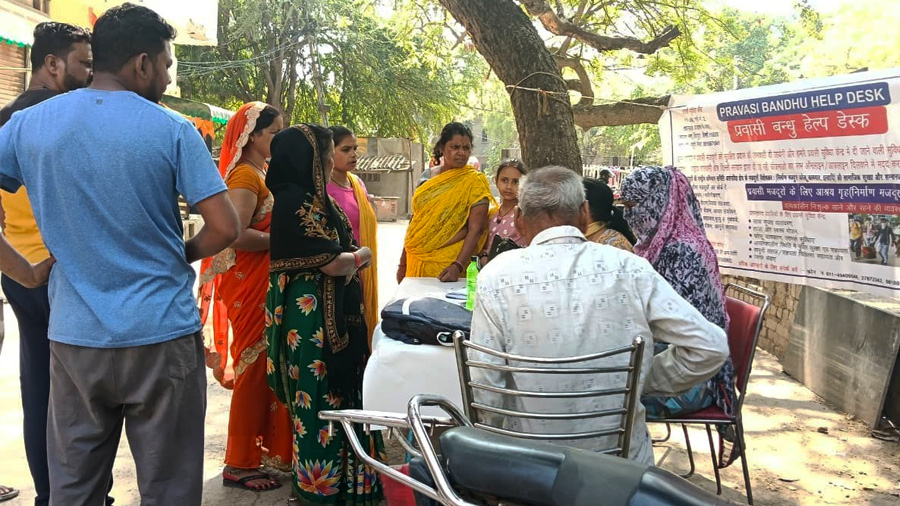
At the help desk, the Pravasi Bandhu team went beyond registrations. They created awareness on safe migration, guiding workers on how to verify employers, avoid fraudulent contracts, and protect themselves from exploitation. They explained key social welfare schemes in simple terms, breaking down complex processes into actionable steps.
Workers were also introduced to Migrant Resource Centres (MRCs), which act as support hubs for migrants seeking information, documentation assistance, and counselling. For those newly arriving in the city, often without shelter or networks, the team highlighted the availability of short-stay shelter homes where migrants can find temporary, safe accommodation while they stabilise their livelihoods.
For many, this was the first time they learned that such systems of support even existed. The model is disarmingly simple. No heavy infrastructure. No dependence on high-end technology. Just proximity, trust, and consistent engagement. And yet, the impact is immediate.
A worker who registers today secures not just benefits, but a safety net. A migrant who understands his rights is less vulnerable to exploitation. A worker who knows where to go in times of distress is no longer alone in an unfamiliar city.
India’s welfare system for migrants and workers is not weak on design. It is weak on last-mile access. The Pravasi Bandhu help desk shows that the last mile does not always need reinvention. It needs presence.
Labour chowks exist in every major city. Migrant clusters are visible, concentrated, and underserved. The cost of setting up such desks is minimal. The outcomes are tangible.
The Pravasi Bandhu programme is already active across source states like Jharkhand, Chhattisgarh, Rajasthan, and Bihar, and extends into major destination hubs including Delhi, Goa, Haryana, Gujarat, and Himachal Pradesh. Working through its partners, it continues to push the boundaries of last-mile access, making every effort to support migrant communities, restore dignity, and ensure that their rights are not just promised, but realised.
Upcoming News
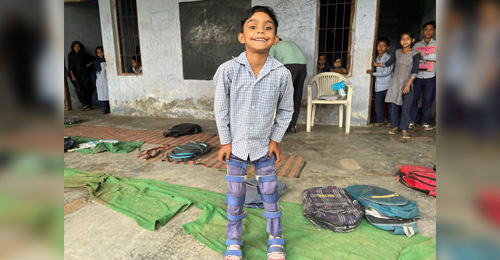
Preventive and corrective care can overcome disability challenges
Seven-year-old Roz Khan used to fall before he could finish a few steps. In his...
LEARN MORE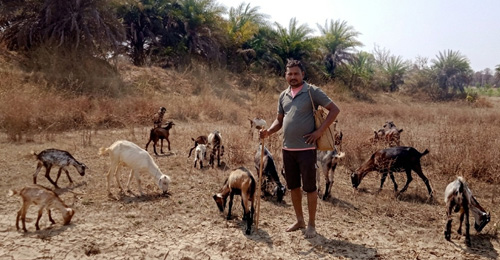
Jharkhand farmer proves livelihood diversification improves family income
Every morning in Surundwada village begins with a purpose for Lachindar Nag. Once burdened by...
LEARN MORE
How Musangu’s Barren Slopes Became a Living Harvest
The dense forests of Ranchi’s Angara Block once cast long, somber shadows over the 382...
LEARN MORE 91 -11 - 2336 3390
  director@caritasindia.org


