
 91 -11 - 2336 3390
 director@caritasindia.org
Caritas India Brings IAGs and Community Organisations Together in Tripura to Strengthen Local Resilience
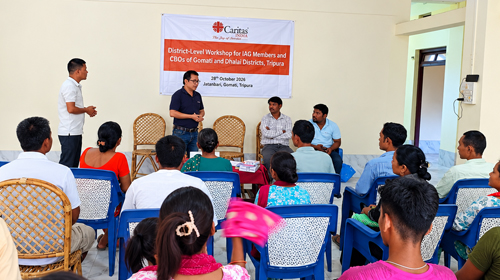
When flood waters rise in the villages of Gomati and Dhalai, the first people to respond are not officials from the state capital. They are neighbours, local volunteers, and community workers who know every household by name. A workshop organised by Caritas India in Tripura late last month was built around this simple truth.
On 28 October 2026, Caritas India brought together 38 participants representing NGOs and Community Based Organisations (CBOs) at Raima Hotel in Jatanbari, Gomati District. The workshop, held in collaboration with local CBOs under the SARAL project, gave members of the Gomati and Dhalai Inter Agency Groups (IAGs) a common platform to share knowledge, exchange field experiences, and reflect together on the climate and disaster risks that are growing across the district. SARAL stands for Strengthening Adaptation Resilience and Livelihoods.
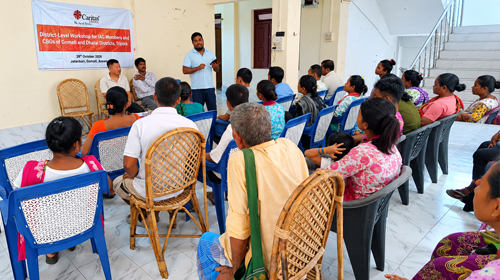
The day began with a welcome address by Mr. Dipendra Tripura, Community Educator from Dhalai District, who facilitated participant introductions and spoke about why coordination among humanitarian agencies, NGOs, and CBOs matters so much in a state where floods arrive almost every year.
Mr. Thangsha Sebastian, Assistant Thematic Lead for Humanitarian Action and Disaster Risk Reduction (HA&DRR) at Caritas India, then spelt out what the workshop hoped to achieve. The group would look at ways to strengthen coordination among humanitarian stakeholders and community organisations, raise community awareness about livestock vaccination and insurance as protection for livelihoods, and document the good practices and lessons emerging from the SARAL project so that others could learn from them.
His message to the room was direct. Effective disaster response begins with strong coordination at the individual, family, and community levels. When early warnings from communities and technical agencies are not shared or acted upon quickly, losses and damage multiply. Community based early warning systems and timely communication, he said, are among the most practical ways to reduce risk and protect lives.
Mr. Thangsha reminded participants that disaster risk reduction is not only about infrastructure, early warnings, and emergency preparedness. It is equally about protecting the livelihood assets of vulnerable households and helping them recover when a shock arrives.
Through livestock vaccination, cattle insurance, agricultural insurance, and community awareness work carried out under the We4Resilience campaign, the SARAL project is helping vulnerable families safeguard their income sources and build financial resilience. The logic is simple. A family that does not lose its animals or its crop does not slide into debt after a disaster.
Mr. Neeraj Uchoi, Assistant at the Department of Agriculture, Government of Tripura, spoke to participants about agricultural insurance, natural resource management, and the government schemes available to farmers. He explained how insurance protects farmers against crop losses caused by floods, erratic rainfall, and other climate related hazards, and encouraged farmers to check their eligibility for these schemes and consult local agriculture officials for guidance on enrolment and claims.
He also urged farmers to invest in sustainable practices such as soil conservation, rainwater harvesting, organic manure application, and crop diversification, while making full use of government support for agricultural inputs, financial assistance, and technical guidance. In his view, awareness of available schemes and the adoption of climate resilient farming practices go hand in hand with protecting livelihoods.
Mr. Bireng Reang, Community Educator, highlighted the importance of vaccinating livestock both before and after floods. Flood waters, stagnant water, contaminated feed, and unhygienic conditions create conditions in which disease spreads quickly among animals. Vaccination before the flood season, wherever feasible, gives animals the time they need to develop immunity. Flood related stress, displacement, and nutritional deficiencies only add to their vulnerability.
Timely vaccination, combined with proper veterinary care and preventive measures after floods, can reduce disease outbreaks, livestock deaths, treatment costs, and financial losses for farming households. Mr. Reang asked farmers to follow recommended vaccination schedules and stay in touch with local veterinary officers.
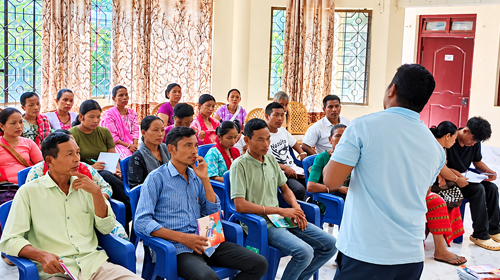
The most powerful moments of the day came when the discussion moved from theory to lived experience. Mr. Reang shared the story of Mr. Thai Majara Mog, a resident of Powang Bari village in Gomati District. Mr. Thai Mog had received ₹5,000 in assistance under the project to purchase a goat worth ₹4,600. When the animal later died of illness, livestock insurance brought him a payout of ₹8,000, enough to buy another animal without borrowing from moneylenders.
Two other families in the area received insurance payouts of ₹30,000 and ₹6,000 after losing their livestock. For households that live close to the margin, these payouts are more than compensation. They are the difference between recovering and falling into a cycle of debt.
The workshop closed with a shared understanding that resilient communities are built not only through preparedness for disasters but through sustained investment in protecting livelihoods, strengthening local coordination, and empowering communities to manage risks together.
With two more such gatherings planned for other parts of the state, the SARAL project continues to show what coordinated humanitarian action looks like when it is anchored in the community. As the climate grows more unpredictable, the networks built in rooms like the one in Jatanbari will matter more than any single intervention.
Upcoming News
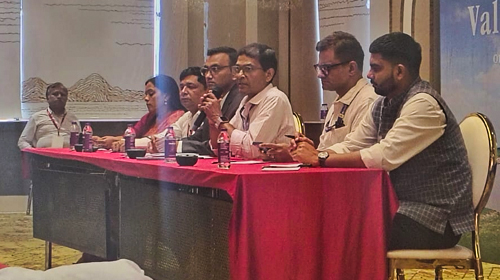
Experts call for last-mile flood early warning systems along Bihar’s ‘ghost river’
Experts, government representatives and community leaders participating in a two-day workshop here have called for...
LEARN MORE
Maize trial in Sagar shows lower-cost farming can match chemical-heavy yields
A farm trial in Tinsua village of Sagar district in Madhya Pradesh has shown that...
LEARN MORE
Take Me to School Every Day: Gunjan’s Determination That Changed Her Story
For 14-year-old Gunjan Bhardwaj of Kewradih village, the words “Take me to school every day…”...
LEARN MORE 91 -11 - 23362735
 director@caritasindia.org


