
 91 -11 - 2336 3390
 director@caritasindia.org
Collective risk calls for collective action

Over the years, water resources in India have witnessed quality deterioration, volumetric reduction, and thereby ecological degradation. Due to an increasing gap between water demand and supply in combination with pollution, ageing infrastructure, floods, droughts, and climate change, it becomes superficial that farmers, communities, flora and fauna are all susceptible to water risks. There have been growing concerns about the change in climate (Increasing temperatures, floods, changing rainfall patterns) and its impact. Access to water sources (both surface and groundwater) per person is gradually declining due to extensive utilisation and poor management of rainwater harvesting systems at the local level.
Ghonta, one of the remote and tribal-dominated villages located in Mandla District has been experiencing a similar water crisis. The people of Ghonta belong to the scheduled tribe. The primary livelihood is agriculture trusted on predominant single paddy crop in rain-fed condition. Half of the small farm households forced to migrate to nearby towns and cities in search of seasonal livelihood leaving their family alone.

In contrast to this, on the introduction of the Smallholder Adaptive Farming and Biodiversity Network (SAFBIN) program in the 10 most marginalised villages of Mandla district, Ghonta considered being one of the potential villages among others. The smallholders categorically formed a smallholder farmer collective (SHFC) in consultation with community leaders and village committee where almost 45 smallholders were enrolled as primary members to learn and educate others on various low-cost natural resource management and agroecological practices.
“We the SHFC and district farmers forum members set together and made a draft plan on how to harvest the rainwater which discussed further with the village committee to explore all possibilities to ensure it,” Shared by one of the SHFC members of Ghonta.

Since water is a shared resource, it increases the importance of working and take collective action in coordination with local stakeholders, village committees, smallholders, and civil societies to help conserve this most precious resource. Smallholder Adaptive Farming and Biodiversity Network program has become the pathway to this process for smallholders by orienting about construction and renovation of different rainwater harvesting structures to restore not only water but also help reduce the runoff and thereby soil erosion. This has led smallholder to be united and aimed towards encouraging initiatives according to their local need and situations.

Further to this, SAFBIN has helped smallholders of Ghonta village to successfully converge renovation of community ponds in collaboration with SAFBIN and the local department where total human days generated was 393 with Rs. 2,34,100/-. The renovated pond has now an improved capacity to irrigate 10acres of cultivable lands covering 15 small farm families.
Smallholder Adaptive Farming and Biodiversity Network (SAFBIN) Program is co-funded by Caritas Switzerland and Caritas Austria apart from contributing towards SDG-2 has also indirectly contributed towards SDG-1, 5, 10, 12, 13, 15, & 17. The program is being implemented by Caritas India through its implementing partner Jabalpur Diocesan Social Service Societies (JDSSS) Mandla and Manav Vikas Seva Sangh (MVSS) Sagar in Madhya Pradesh India.
Upcoming News
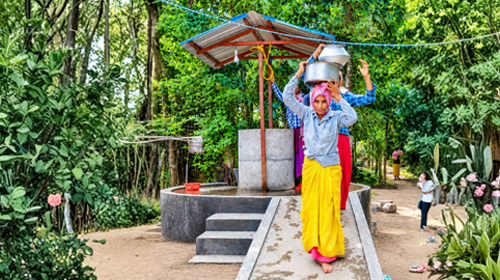
Bringing Water Closer to Home: An Inclusive Community Resilience Initiative in Assam
When floodwater enters 13/10 Grant Village in Assam, it also reaches the sources families depend...
LEARN MORE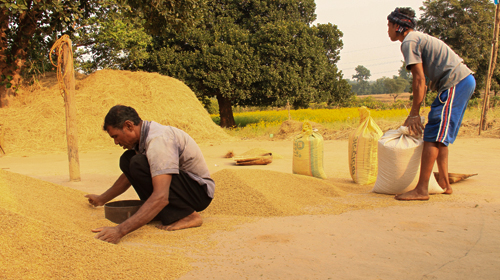
A Harvest Too Small for the Market? Study Points to the Power of Selling Together
A farmer may have a harvest to sell, yet too little produce to make the...
LEARN MORE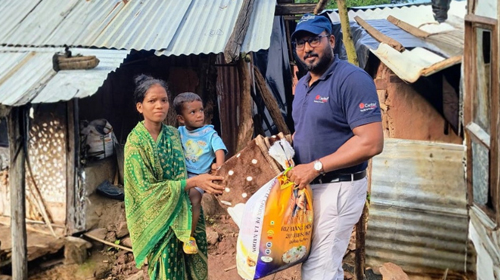
Caritas India Rushes Relief to Cyclone Arnab Hit Families in Odisha’s Gajapati
Caritas India has begun distributing emergency ration kits and blankets to families battered by Cyclone...
LEARN MORE 91 -11 - 23362735
 director@caritasindia.org


