
 91 -11 - 2336 3390
  director@caritasindia.org
 Comprehensive school safety training building disaster ready schools in Odisha
Cyclones do not wait for school hours to end. Floodwaters do not check timetables. In coastal Odisha, disaster is not a distant threat. It is seasonal. Sometimes sudden. Always disruptive.
Schools sit at the heart of these communities. When they collapse, learning stops. When they are unprepared, children pay the price.
This is precisely why Caritas India, with the support of Caritas Japan, is implementing a resilience-building initiative in the coastal districts of Puri, Balasore and Ganjam. The project titled, “Empowering Communities for Resilience Building in Odisha” aims to strengthen community-based disaster preparedness by integrating disaster risk reduction into schools and local governance systems. It focuses on building institutional readiness, equipping communities with practical skills, and ensuring that education continues even in times of crisis.
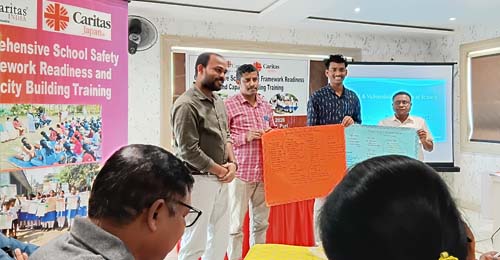
The Comprehensive School Safety Framework readiness and capacity building training held on 11–12 February 2026 in Puri was a key activity under this larger project.
Thirty participants including Teachers. Sarpanches, Members of village disaster management committees, School Management Committee representatives, and Community volunteers came together for this training.
The objective was to strengthen school-level preparedness in disaster-prone coastal regions and translate policy into practice.
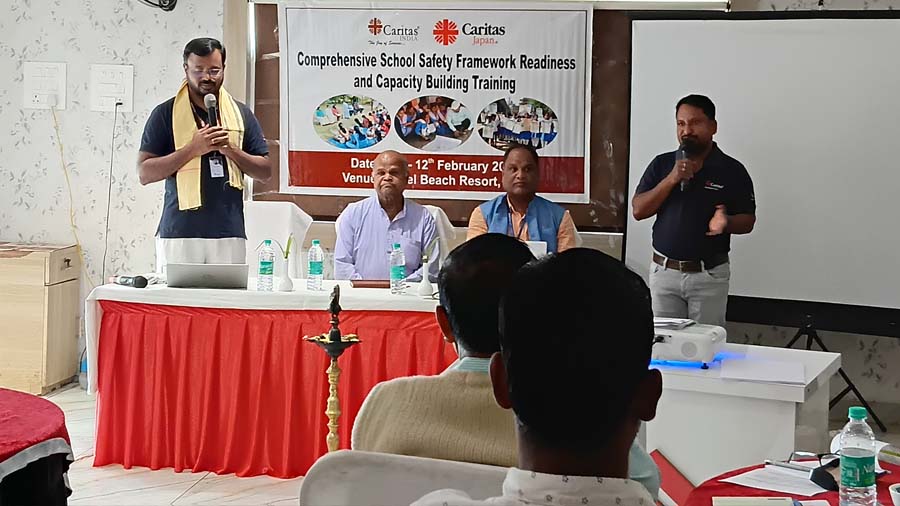
Fr Benny Edayath, Assistant Executive Director of Caritas India, opened the programme by underlining the urgency of institutionalising school safety in vulnerable geographies. Mr John Lima, programme associate – HADRR, introduced the Comprehensive School Safety Framework and its operational components. The technical sessions were facilitated by Mr Bapi Satyajit Sahoo, disaster risk reduction professional associated with Odisha State Disaster Management Authority, who guided participants through risk assessment tools, planning templates and real-life response scenarios.
The training aligns with the 2016 School Safety Policy issued by the National Disaster Management Authority. But compliance alone does not save lives. Preparedness does.
Participants were guided to prepare and refine school disaster management plans. Hazard and vulnerability assessments were broken down into practical exercises. Mock drills were repositioned as routine preparedness measures, not annual formalities. Stronger coordination between schools, gram panchayats and local disaster management structures was emphasised.
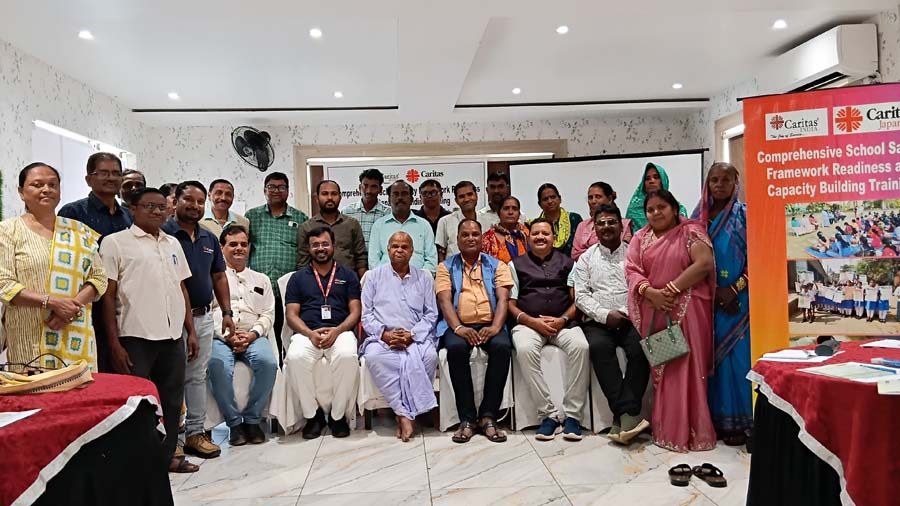
The training reinforced the right to safe, inclusive and uninterrupted education. Schools were recognised as critical community institutions that must remain functional during crises. In many coastal villages, school buildings double as shelters and coordination centres during disasters. Their safety determines community resilience.
By embedding disaster risk reduction within education systems, the project strengthens long-term resilience while contributing to broader commitments on quality education, sustainable communities and climate action.
Special emphasis was placed on child-centred and gender-sensitive approaches. Every child must be protected. Every voice must count.
Through participatory methods and school-specific planning, participants shifted from awareness to readiness. They mapped risks. Defined responsibilities. Identified structural vulnerabilities. Committed to regular review and practice.
This activity is not an isolated training. It is part of a structured effort to build resilient education systems in Odisha’s disaster-vulnerable regions.
Upcoming News
ICMOD and Caritas India join to shape strategic flood resilience plan for Bihar
Every monsoon, rivers flowing down from Nepal push north Bihar into crisis mode. Embankments strain,...
LEARN MORE
Migrant domestic worker freed in Delhi after months of exploitation
Caritas India has secured the release and safe return of a young domestic worker from...
LEARN MORE
How Gond women turned a common water body into food security and collective prosperity
It might not seem obvious why a small, muddy village pond could matter in a...
LEARN MORE 91 -11 - 2336 3390
  director@caritasindia.org


