
 91 -11 - 2336 3390
  director@caritasindia.org
 Preventive and corrective care can overcome disability challenges
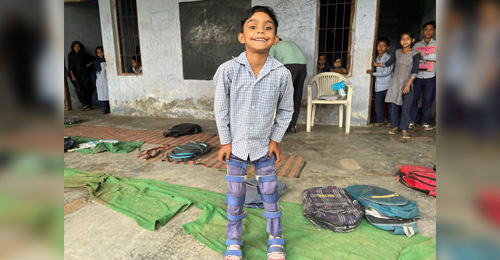
Seven-year-old Roz Khan used to fall before he could finish a few steps. In his village in Kurali, every step came with effort. Every movement carried the risk of falling. Still, he tried. He showed up. He wanted to go to school, to play, to be like other children.
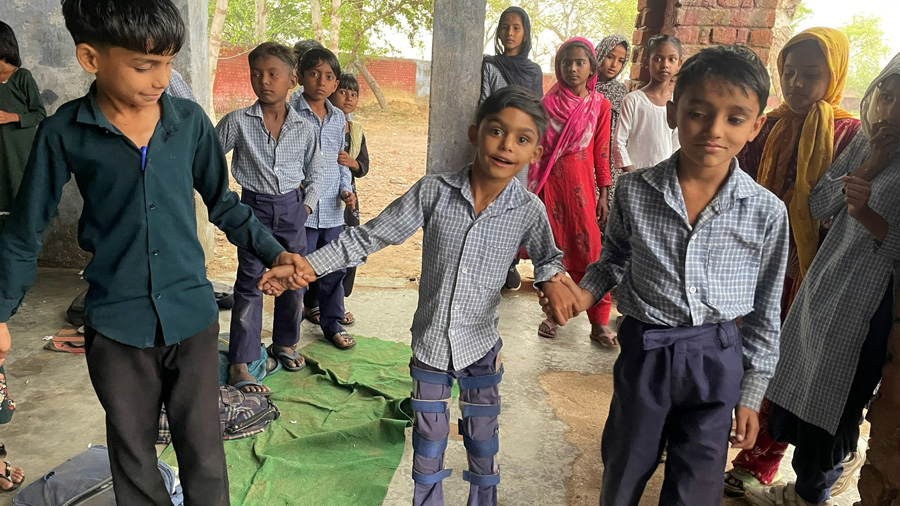
Born with mild cerebral palsy and deformities in both legs, Roz struggled with balance and mobility. His knees bent inward, his feet were misaligned, and his walking was unstable. For his family, the condition was confusing and overwhelming. Like many in rural communities, they searched for answers in faith, moving from one place to another, hoping time would correct what they did not yet understand.
But time alone does not heal untreated conditions. What stood between Roz and a better life was not just his disability, but a deeper gap. A gap in awareness. A gap in early identification. One shaped by limited access to health education, and often by social realities such as inadequate spacing between children and lack of informed maternal care. These gaps continue to delay timely intervention for thousands of children.
This is where the response began to take shape. Caritas India, in collaboration with Highway Roop Precision Technologies Ltd., stepped in through a Community-Based Rehabilitation project. The initiative focuses on reaching the most marginalized communities, ensuring that children with disabilities are identified early and supported consistently.
The approach is simple, but transformative. It connects families to social security schemes, improves accessibility, promotes early identification, and supports school enrollment. It also strengthens communities by forming self-help groups, creating pathways for income and dignity.
For Roz, the turning point came through a small but powerful intervention. Not surgery. Not hospitalization. A customised orthotic brace.
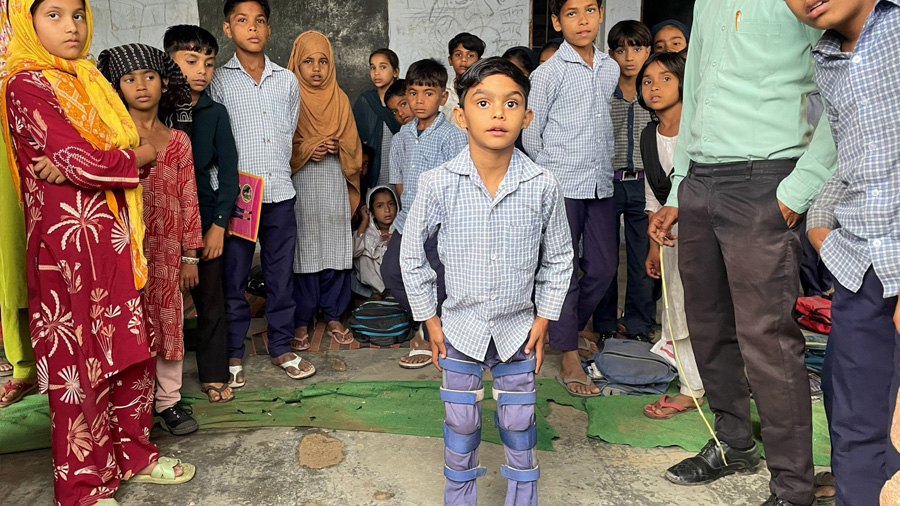
When he was fitted with Knee-Ankle-Foot Orthoses, everything began to shift. The brace supported his legs, corrected alignment, and reduced strain on his joints. It gave him the stability he had never experienced before.
Guiding this transformation was Dr. Shivpujan, a physiotherapist and health coordinator in the program. He prescribed both preventive and corrective measures to manage Roz’s condition, ensuring that the intervention addressed not just the present difficulty but the future risk. Alongside the orthosis, Roz began regular therapy sessions based on a home protocol, with daily monitoring through a follow-up chart.
The change was visible. Roz began to walk with greater ease. The falls reduced. His steps became steady. The fear that once held him back started to fade. Slowly, he returned to school, no longer struggling to keep up, but eager to participate.
Confidence followed movement. He began engaging more in daily activities. He played. He moved independently. He smiled more.
Stories like Roz’s underline a critical truth. When deformities are identified early, they can often be corrected or effectively managed. Preventive and corrective care, when delivered on time, can enable walking, improve mobility, and support cognitive and social development alongside physical progress.
The scale of the challenge is vast. India is home to 2.68 crore persons with disabilities, accounting for 2.21 percent of the population, according to Census 2011. Behind each number is a life waiting for timely support.
What makes the difference is not complexity. It is access. Assistive devices like orthoses are not just medical tools. They are enablers of dignity. They restore movement, unlock education, and rebuild confidence. For children in rural settings, they can mean the difference between isolation and inclusion.
Roz’s journey is not just about walking better. It is about reclaiming childhood. It is about what becomes possible when preventive care meets timely intervention.
Supporting persons with disabilities is not an act of charity. It is an investment in human potential. A simple intervention, delivered early, can change the direction of a life.
Upcoming News
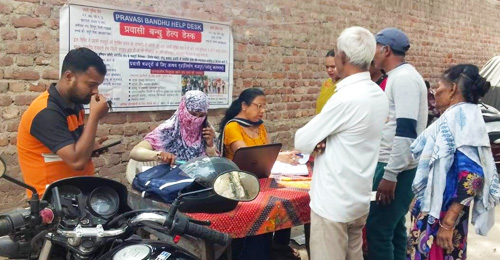
A help desk at Delhi labour chowks is fixing India’s migrant welfare gap
At a crowded labour chowk in Rohini, where men gather at dawn hoping for a...
LEARN MORE
Jharkhand farmer proves livelihood diversification improves family income
Every morning in Surundwada village begins with a purpose for Lachindar Nag. Once burdened by...
LEARN MORE
How Musangu’s Barren Slopes Became a Living Harvest
The dense forests of Ranchi’s Angara Block once cast long, somber shadows over the 382...
LEARN MORE 91 -11 - 2336 3390
  director@caritasindia.org


