
 91 -11 - 2336 3390
  director@caritasindia.org
 The International Conference on Disaster Risk Reduction (ICDRR) will objectively deliberate to put Communities at the heart of all solutions at the backdrop increasing natural and man-made disasters as cited by the Sendai Framework for Disaster Risk Reduction 2015-2030 adopted at the Third UN World Conference in Sendai, Japan (March 18, 2015) succeeding the Hyogo Framework for Action 2005-10.
It is expected that ICDRR will enable an interface between the community representatives, policy makers and the actors on ground in developing coherence amongst the varied actors for relooking into the DRR priorities; align them to community needs to fore-ground the communities as change agents and stakeholders in disaster resilience.


OBJECTIVES
Provide an opportunity for practitioners and corporate entities to share experiences and good practices /interventions in building resilience through different sectors of disaster management in India and selected projects from South and South East Asia region.
Mutual learning from the best practices in the identified themes of the conference.
Explore the path ahead towards workable models in the areas of disaster risk mapping and management through focus on technology innovation, risk transfer through community insurance; psycho social support post disasters; and livelihood security.
STRATEGIC HIGHLIGHTS
I. Disaster Risk Mapping through technological innovation: Localise them for community use
II. Disaster Risk Management: Secured Livelihood, Health and Psychosocial well-being
III. Risk Management through Risk Transfer: Insurance Models
WHO CAN PARTICIPATE?
The Conference will be attended by disaster management practitioners from at-risk communities, government agencies, United Nations agencies, non-government organisations, community-based organisations, corporate entities in banking sector, academicians. Representatives of donors, regional organisations and other specialised agencies are encouraged to attend the Conference to share their insights. Preference will be given to participants from India, South and South East Asia regions.
EXPECTED OUTCOME
The conference shall demonstrate best practices and models for replication and adaptability. It will also develop coherence towards qualifying various aspects of resilience.
PARTNERS
The Conference will be organised by Caritas India, while collaboration will be actively sought with the NDMA, NIDM, and other relevant agencies.
The International Conference on Disaster Risk Reduction (ICDRR) will objectively deliberate to put Communities at the heart of all solutions at the backdrop increasing natural and man-made disasters as cited by the Sendai Framework for Disaster Risk Reduction 2015-2030 adopted at the Third UN World Conference in Sendai, Japan (March 18, 2015) succeeding the Hyogo Framework for Action 2005-10.
It is expected that ICDRR will enable an interface between the community representatives, policy makers and the actors on ground in developing coherence amongst the varied actors for relooking into the DRR priorities; align them to community needs to fore-ground the communities as change agents and stakeholders in disaster resilience.
OBJECTIVES
Provide an opportunity for practitioners and corporate entities to share experiences and good practices /interventions in building resilience through different sectors of disaster management in India and selected projects from South and South East Asia region.
Mutual learning from the best practices in the identified themes of the conference.
Explore the path ahead towards workable models in the areas of disaster risk mapping and management through focus on technology innovation, risk transfer through community insurance; psycho social support post disasters; and livelihood security.
STRATEGIC HIGHLIGHTS
I. Disaster Risk Mapping through technological innovation: Localise them for community use
II. Disaster Risk Management: Secured Livelihood, Health and Psychosocial well-being
III. Risk Management through Risk Transfer: Insurance Models
WHO CAN PARTICIPATE?
The Conference will be attended by disaster management practitioners from at-risk communities, government agencies, United Nations agencies, non-government organisations, community-based organisations, corporate entities in banking sector, academicians. Representatives of donors, regional organisations and other specialised agencies are encouraged to attend the Conference to share their insights. Preference will be given to participants from India, South and South East Asia regions.
EXPECTED OUTCOME
The conference shall demonstrate best practices and models for replication and adaptability. It will also develop coherence towards qualifying various aspects of resilience.
PARTNERS
The Conference will be organised by Caritas India, while collaboration will be actively sought with the NDMA, NIDM, and other relevant agencies.
Pan Asia Farm Fest (PAFF) was organized by Caritas India on March 25-16, 2014 at New Delhi. The event was attended by more than 500 farmers and development professionals including 35 participants from various parts of Asia.
The proceedings during the first day of the event were inaugurated by His Grace Anil Couto, Archbishop of Delhi. This was held at the Diocesan Community Centre. Ms. Vandana Shiva, an eminent environment activist, and anti-globalisation author delivered the keynote address.
“Greenovations” – An exhibition displaying the innovations and best practices of various farmers and partners through 31 exhibition stalls were organized as a side event. His Excellency Lumen Monteiro, Chairman, Caritas India inaugurated the exhibition.
The technical sessions of the conference were organized in plenary and parallel sessions. One of the major attractions of the event was the farmers’ session where farmers shared their stories of change. Various approaches and strategies followed by Caritas India in the sector were also shared during a dedicated session.
As part of the open mike discussions, farmers from various parts of the country urged the need to form a National Farmers Forum. Farmers have requested Caritas India to organize more such events at regional and national level.
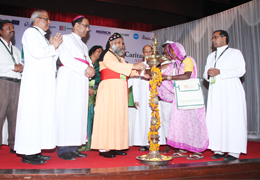
A public function was organized during the second day of the programme to commemorate the 2014 International Year of Family Farming. Caritas India is among the very few organizations in India which were part of the global campaign to declare 2014 as International Year of Family Farming. His Beatitude Moran Mor Baselios Cardinal Cleemis inaugurated the campaign in the presence of a farmer family. Symbolically they have committed to promoting Family farming on behalf of all who were gathered for the programme. The farmer couple along with their children was facilitated during the occasion.
Dr. Devender Sharma, eminent agriculture policy analyst, in his keynote address, expressed grave concern over the global conspiracy for the corporatizing agriculture sector and stripping farmers of their wealth of agriculture.
During the event, six farmers from across India were felicitated for their innovations and farming successes. Three knowledge products of Caritas India in the form of booklets were released during the occasion.
A woman farmer read out the farmers’ charter finalized on the basis of the recommendations that emerged from the deliberations of the first day which was organized in the run-up to the farmers’ convention.
Caritas India is committed to taking forward the recommendations of the farmers to form and functionalised the National Smallholder Farmers’ Forum. The proposed forum will have a federated structure starting from the Panchayat level to the National level. In order to begin the work, Caritas India will start working with the existing Farmers’ Collectives and District Forums and these institutions will be strengthened through partners and farmers to advocate for more smallholder farmer friendly policies and developmental interventions.
Volunteering in India
Social, Cultural and Traditional Underpinnings
Strong commitment towards the change one aspires to make or work towards, beyond oneself, is the key to effective volunteering. The process not just leads to external transformation but also changes and sensitises the volunteer towards larger realities. Here, the volunteer becomes an enabler of change, by bridging the gap between the subalterns and power holders /influencers. Such voluntary commitments continue to be demonstrated since the times of Rishis (sage), Christian missionaries, Ramakrishna Mission, freedom struggle and subsequent social reform movements.
Volunteering and Sustainable Development Goals
Strong commitment towards the change one aspires to make or work towards, beyond oneself, is the key to effective volunteering. The process not just leads to external transformation but also changes and sensitises the volunteer towards larger realities. Here, the volunteer becomes an enabler of change, by bridging the gap between the subalterns and power holders /influencers. Such voluntary commitments continue to be demonstrated since the times of Rishis (sage), Christian missionaries, Ramakrishna Mission, freedom struggle and subsequent social reform movements.
Strong commitment towards the change one aspires to make or work towards, beyond oneself, is the key to effective volunteering. The process not just leads to external transformation but also changes and sensitises the volunteer towards larger realities. Here, the volunteer becomes an enabler of change, by bridging the gap between the subalterns and power holders /influencers. Such voluntary commitments continue to be demonstrated since the times of Rishis (sage), Christian missionaries, Ramakrishna Mission, freedom struggle and subsequent social reform movements.
Strong commitment towards the change one aspires to make or work towards, beyond oneself, is the key to effective volunteering. The process not just leads to external transformation but also changes and sensitises the volunteer towards larger realities. Here, the volunteer becomes an enabler of change, by bridging the gap between the subalterns and power holders /influencers. Such voluntary commitments continue to be demonstrated since the times of Rishis (sage), Christian missionaries, Ramakrishna Mission, freedom struggle and subsequent social reform movements.
Volunteering in India
Social, Cultural and Traditional Underpinnings
Strong commitment towards the change one aspires to make or work towards, beyond oneself, is the key to effective volunteering. The process not just leads to external transformation but also changes and sensitises the volunteer towards larger realities. Here, the volunteer becomes an enabler of change, by bridging the gap between the subalterns and power holders /influencers. Such voluntary commitments continue to be demonstrated since the times of Rishis (sage), Christian missionaries, Ramakrishna Mission, freedom struggle and subsequent social reform movements.
Volunteering and Sustainable Development Goals
Strong commitment towards the change one aspires to make or work towards, beyond oneself, is the key to effective volunteering. The process not just leads to external transformation but also changes and sensitises the volunteer towards larger realities. Here, the volunteer becomes an enabler of change, by bridging the gap between the subalterns and power holders /influencers. Such voluntary commitments continue to be demonstrated since the times of Rishis (sage), Christian missionaries, Ramakrishna Mission, freedom struggle and subsequent social reform movements.
Strong commitment towards the change one aspires to make or work towards, beyond oneself, is the key to effective volunteering. The process not just leads to external transformation but also changes and sensitises the volunteer towards larger realities. Here, the volunteer becomes an enabler of change, by bridging the gap between the subalterns and power holders /influencers. Such voluntary commitments continue to be demonstrated since the times of Rishis (sage), Christian missionaries, Ramakrishna Mission, freedom struggle and subsequent social reform movements.
Strong commitment towards the change one aspires to make or work towards, beyond oneself, is the key to effective volunteering. The process not just leads to external transformation but also changes and sensitises the volunteer towards larger realities. Here, the volunteer becomes an enabler of change, by bridging the gap between the subalterns and power holders /influencers. Such voluntary commitments continue to be demonstrated since the times of Rishis (sage), Christian missionaries, Ramakrishna Mission, freedom struggle and subsequent social reform movements.
Volunteering in India
Social, Cultural and Traditional Underpinnings
Strong commitment towards the change one aspires to make or work towards, beyond oneself, is the key to effective volunteering. The process not just leads to external transformation but also changes and sensitises the volunteer towards larger realities. Here, the volunteer becomes an enabler of change, by bridging the gap between the subalterns and power holders /influencers. Such voluntary commitments continue to be demonstrated since the times of Rishis (sage), Christian missionaries, Ramakrishna Mission, freedom struggle and subsequent social reform movements.
Volunteering and Sustainable Development Goals
Strong commitment towards the change one aspires to make or work towards, beyond oneself, is the key to effective volunteering. The process not just leads to external transformation but also changes and sensitises the volunteer towards larger realities. Here, the volunteer becomes an enabler of change, by bridging the gap between the subalterns and power holders /influencers. Such voluntary commitments continue to be demonstrated since the times of Rishis (sage), Christian missionaries, Ramakrishna Mission, freedom struggle and subsequent social reform movements.
Strong commitment towards the change one aspires to make or work towards, beyond oneself, is the key to effective volunteering. The process not just leads to external transformation but also changes and sensitises the volunteer towards larger realities. Here, the volunteer becomes an enabler of change, by bridging the gap between the subalterns and power holders /influencers. Such voluntary commitments continue to be demonstrated since the times of Rishis (sage), Christian missionaries, Ramakrishna Mission, freedom struggle and subsequent social reform movements.
Strong commitment towards the change one aspires to make or work towards, beyond oneself, is the key to effective volunteering. The process not just leads to external transformation but also changes and sensitises the volunteer towards larger realities. Here, the volunteer becomes an enabler of change, by bridging the gap between the subalterns and power holders /influencers. Such voluntary commitments continue to be demonstrated since the times of Rishis (sage), Christian missionaries, Ramakrishna Mission, freedom struggle and subsequent social reform movements.
Volunteering in India
Social, Cultural and Traditional Underpinnings
Strong commitment towards the change one aspires to make or work towards, beyond oneself, is the key to effective volunteering. The process not just leads to external transformation but also changes and sensitises the volunteer towards larger realities. Here, the volunteer becomes an enabler of change, by bridging the gap between the subalterns and power holders /influencers. Such voluntary commitments continue to be demonstrated since the times of Rishis (sage), Christian missionaries, Ramakrishna Mission, freedom struggle and subsequent social reform movements.
Volunteering and Sustainable Development Goals
Strong commitment towards the change one aspires to make or work towards, beyond oneself, is the key to effective volunteering. The process not just leads to external transformation but also changes and sensitises the volunteer towards larger realities. Here, the volunteer becomes an enabler of change, by bridging the gap between the subalterns and power holders /influencers. Such voluntary commitments continue to be demonstrated since the times of Rishis (sage), Christian missionaries, Ramakrishna Mission, freedom struggle and subsequent social reform movements.
Strong commitment towards the change one aspires to make or work towards, beyond oneself, is the key to effective volunteering. The process not just leads to external transformation but also changes and sensitises the volunteer towards larger realities. Here, the volunteer becomes an enabler of change, by bridging the gap between the subalterns and power holders /influencers. Such voluntary commitments continue to be demonstrated since the times of Rishis (sage), Christian missionaries, Ramakrishna Mission, freedom struggle and subsequent social reform movements.
Strong commitment towards the change one aspires to make or work towards, beyond oneself, is the key to effective volunteering. The process not just leads to external transformation but also changes and sensitises the volunteer towards larger realities. Here, the volunteer becomes an enabler of change, by bridging the gap between the subalterns and power holders /influencers. Such voluntary commitments continue to be demonstrated since the times of Rishis (sage), Christian missionaries, Ramakrishna Mission, freedom struggle and subsequent social reform movements.
Volunteering in India
Social, Cultural and Traditional Underpinnings
Strong commitment towards the change one aspires to make or work towards, beyond oneself, is the key to effective volunteering. The process not just leads to external transformation but also changes and sensitises the volunteer towards larger realities. Here, the volunteer becomes an enabler of change, by bridging the gap between the subalterns and power holders /influencers. Such voluntary commitments continue to be demonstrated since the times of Rishis (sage), Christian missionaries, Ramakrishna Mission, freedom struggle and subsequent social reform movements.
Volunteering and Sustainable Development Goals
Strong commitment towards the change one aspires to make or work towards, beyond oneself, is the key to effective volunteering. The process not just leads to external transformation but also changes and sensitises the volunteer towards larger realities. Here, the volunteer becomes an enabler of change, by bridging the gap between the subalterns and power holders /influencers. Such voluntary commitments continue to be demonstrated since the times of Rishis (sage), Christian missionaries, Ramakrishna Mission, freedom struggle and subsequent social reform movements.
Strong commitment towards the change one aspires to make or work towards, beyond oneself, is the key to effective volunteering. The process not just leads to external transformation but also changes and sensitises the volunteer towards larger realities. Here, the volunteer becomes an enabler of change, by bridging the gap between the subalterns and power holders /influencers. Such voluntary commitments continue to be demonstrated since the times of Rishis (sage), Christian missionaries, Ramakrishna Mission, freedom struggle and subsequent social reform movements.
Strong commitment towards the change one aspires to make or work towards, beyond oneself, is the key to effective volunteering. The process not just leads to external transformation but also changes and sensitises the volunteer towards larger realities. Here, the volunteer becomes an enabler of change, by bridging the gap between the subalterns and power holders /influencers. Such voluntary commitments continue to be demonstrated since the times of Rishis (sage), Christian missionaries, Ramakrishna Mission, freedom struggle and subsequent social reform movements.
Volunteering in India
Social, Cultural and Traditional Underpinnings
Strong commitment towards the change one aspires to make or work towards, beyond oneself, is the key to effective volunteering. The process not just leads to external transformation but also changes and sensitises the volunteer towards larger realities. Here, the volunteer becomes an enabler of change, by bridging the gap between the subalterns and power holders /influencers. Such voluntary commitments continue to be demonstrated since the times of Rishis (sage), Christian missionaries, Ramakrishna Mission, freedom struggle and subsequent social reform movements.
Volunteering and Sustainable Development Goals
Strong commitment towards the change one aspires to make or work towards, beyond oneself, is the key to effective volunteering. The process not just leads to external transformation but also changes and sensitises the volunteer towards larger realities. Here, the volunteer becomes an enabler of change, by bridging the gap between the subalterns and power holders /influencers. Such voluntary commitments continue to be demonstrated since the times of Rishis (sage), Christian missionaries, Ramakrishna Mission, freedom struggle and subsequent social reform movements.
Strong commitment towards the change one aspires to make or work towards, beyond oneself, is the key to effective volunteering. The process not just leads to external transformation but also changes and sensitises the volunteer towards larger realities. Here, the volunteer becomes an enabler of change, by bridging the gap between the subalterns and power holders /influencers. Such voluntary commitments continue to be demonstrated since the times of Rishis (sage), Christian missionaries, Ramakrishna Mission, freedom struggle and subsequent social reform movements.
Strong commitment towards the change one aspires to make or work towards, beyond oneself, is the key to effective volunteering. The process not just leads to external transformation but also changes and sensitises the volunteer towards larger realities. Here, the volunteer becomes an enabler of change, by bridging the gap between the subalterns and power holders /influencers. Such voluntary commitments continue to be demonstrated since the times of Rishis (sage), Christian missionaries, Ramakrishna Mission, freedom struggle and subsequent social reform movements.
 91 -11 - 23362735
  director@caritasindia.org


