
 91 -11 - 2336 3390
  director@caritasindia.org
 Lessons in survival: a coastal Odisha village rehearses for the next cyclone
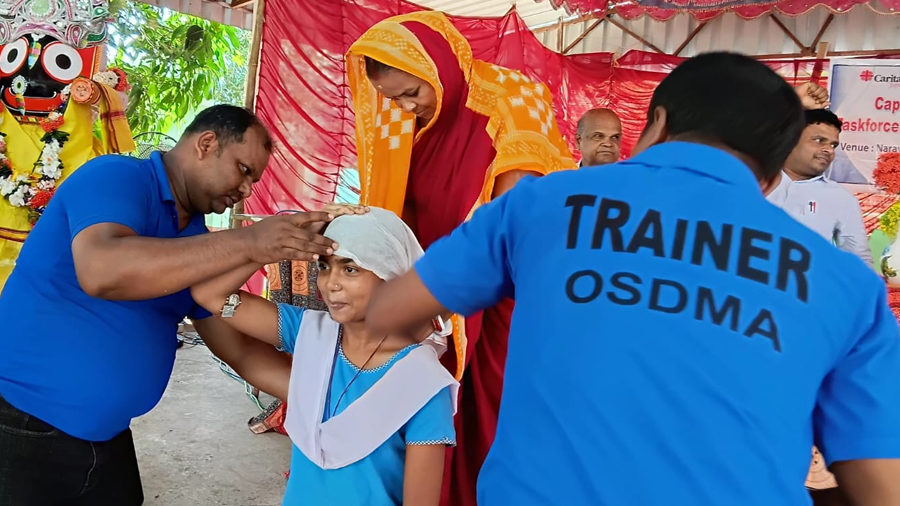
A trainer in an OSDMA t-shirt steadies a young girl’s head as another instructor fits put the bandage on her head, the two of them working in tandem. A few streets away, two teenage boys stand by their bicycles in school uniform, orange UltraSafe life jackets strapped over their shirts, yellow OSDMA hard hats on their heads and safety whistles clenched between their teeth. Behind them, a rescue tube is lashed to a bicycle frame with rope, ready to be pedalled to wherever it’s needed. This was Narayanpur village, Balasore, and for a few hours the equipment of a real flood rescue was being tried on by children for the first time.
Odisha’s coast is one of the most cyclone-exposed stretches of land in India, regularly battered by storm surges, flash floods and the tropical cyclones that form in the Bay of Bengal with growing frequency. Balasore district, where Narayanpur sits, has repeatedly found itself in the path of these storms. For remote, low-lying villages like this one, the gap between a warning being issued and a family knowing what to actually do with that warning has often been the difference between survival and tragedy.
It’s a gap that Caritas India has been trying to close. Under its Empowering Communities for Resilience Building Project, the organisation ran a full-scale emergency evacuation mock drill in Narayanpur, working alongside the district’s official disaster authorities, the village’s own disaster management committee, and the school’s safety committee. It was an attempt to prove that government agencies, schools and communities can act as one coordinated system rather than three separate ones scrambling to catch up with each other when a storm actually hits.
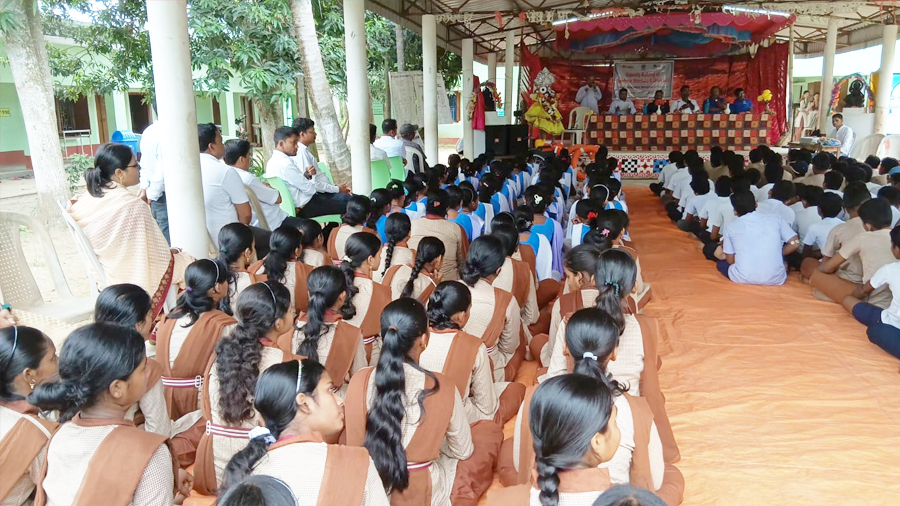
More than 190 schoolchildren and 77 committee members, teachers, volunteers and local stakeholders took part. Under a simulated disaster scenario, they rehearsed everything from early warning dissemination and search-and-rescue coordination to safe evacuation and assembly, the unglamorous, procedural choreography that, repeated often enough, is designed to become instinct rather than guesswork.
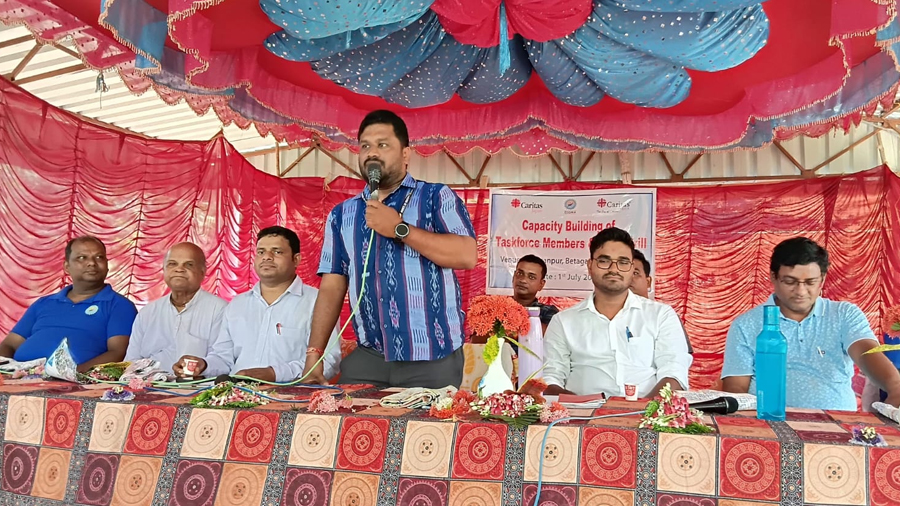
Shri Abanikanta Bhuyan, District Project Officer with the Odisha State Disaster Management Authority, attended as chief guest, alongside Satyabrata Sahu and Gourango Das, radio engineers who help operate the district’s Early Warning Dissemination System, and Priyabrata Giri, the Gram Panchayat Extension Officer for Baliapal Block, a lineup that reflects how many different institutions now have to move in step for a warning to travel from a control room to a classroom in time.
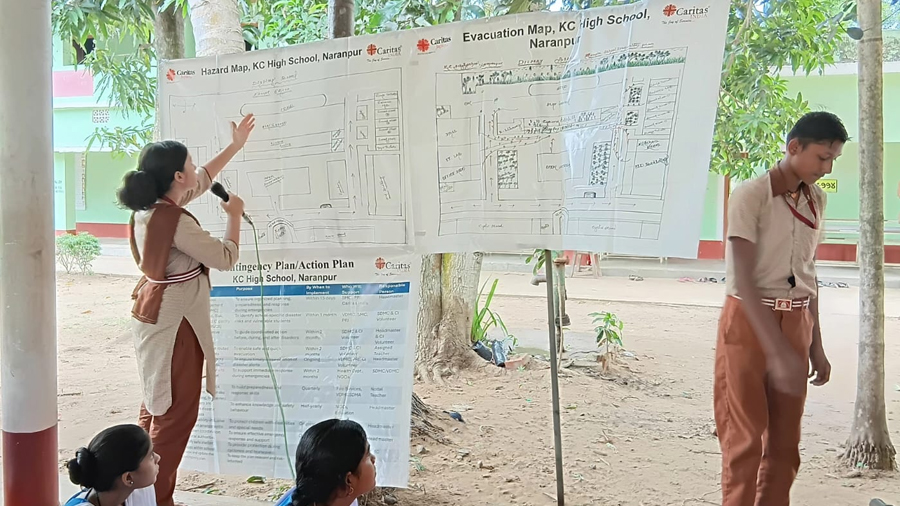
Under the school’s porch, a student stood before a hand-drawn Hazard Map and Evacuation Map of KC High School, pinned up alongside a Contingency Plan/Action Plan poster bearing the Caritas India logo, talking her classmates through the safest routes out of the building and where the assembly points lay. Elsewhere, another group of students took on the role of the warning chain itself: one walked ahead with a megaphone, alerting neighbours down the village road, while others followed on bicycles rigged with rescue buoys, playing out exactly how a warning and a rescue team might move through Narayanpur if a real cyclone or flood were bearing down.
That institutional convergence is precisely the point. Disaster researchers across South Asia have long argued that early warning systems only save lives if the last mile village, school, and household actually rehearse what to do once the alarm sounds. A sophisticated radio warning system is of limited use if the people receiving it have never practised an evacuation route, don’t know where the safe assembly point is, or freeze rather than move when the siren goes off for real.
That is the lesson organisers say drills like Narayanpur’s are meant to instil: not just awareness of risk, but muscle memory for responding to it. Task force members and school safety committees rehearsed their coordination roles alongside the students, with the goal of building confidence that will hold up under the pressure of an actual emergency, when confusion and fear tend to override training unless that training has been repeated enough times to become automatic.
Caritas India frames the Narayanpur drill as part of a wider push to build resilience by getting government departments, schools and community organisations to work in genuine partnership. At Narayanpur, that readiness is now something children have literally worn on their bodies, the weight of a life jacket across the shoulders, a helmet strap under the chin, a whistle between the teeth, so that if the real thing ever comes, it won’t be the first time.
Upcoming News
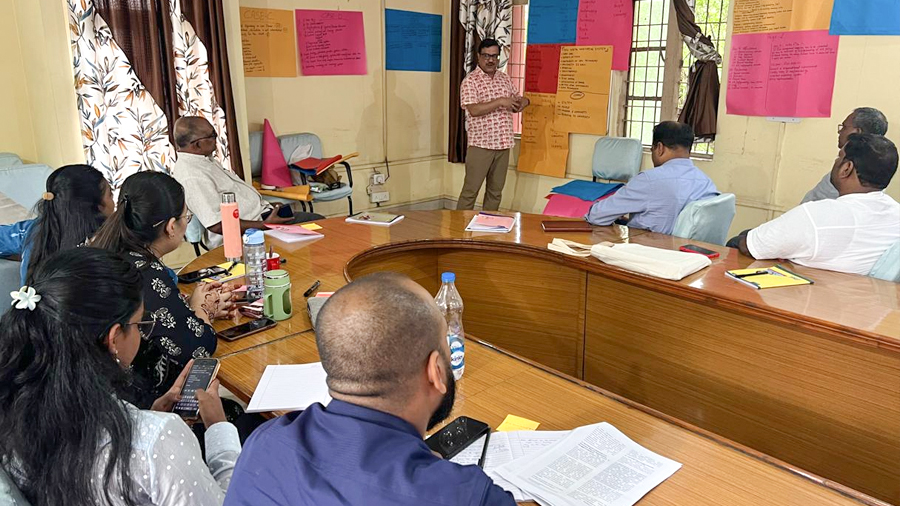
When NGOs Grow, What Breaks First? Caritas India Tackles the Answer in Raipur
Three-day workshop arms executive leaders with governance tools, a 20-policy framework and practical fixes for...
LEARN MORE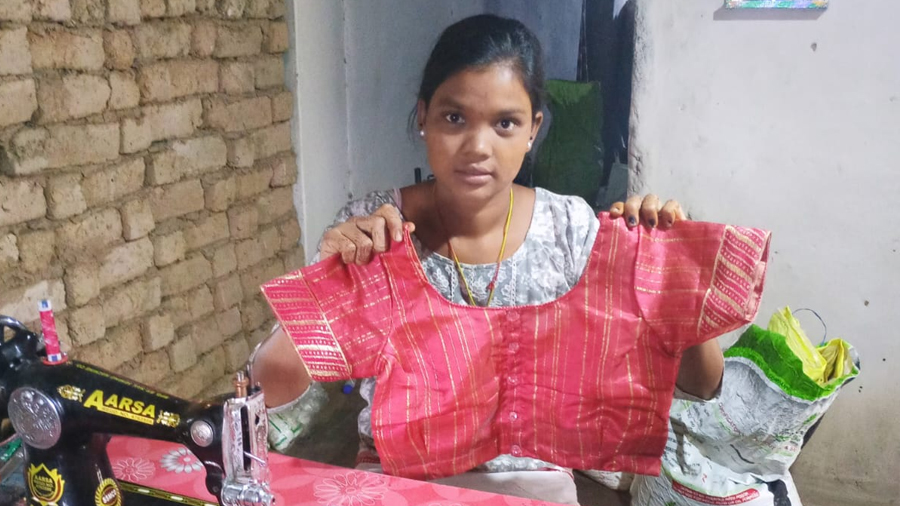
Nine Kilometres Through the Jungle: How Poornima Stitched Her Own Future
For 19 year old Poornima Rawat of Rajamma village in Lailunga block of Chhattisgarh's Raigarh...
LEARN MORE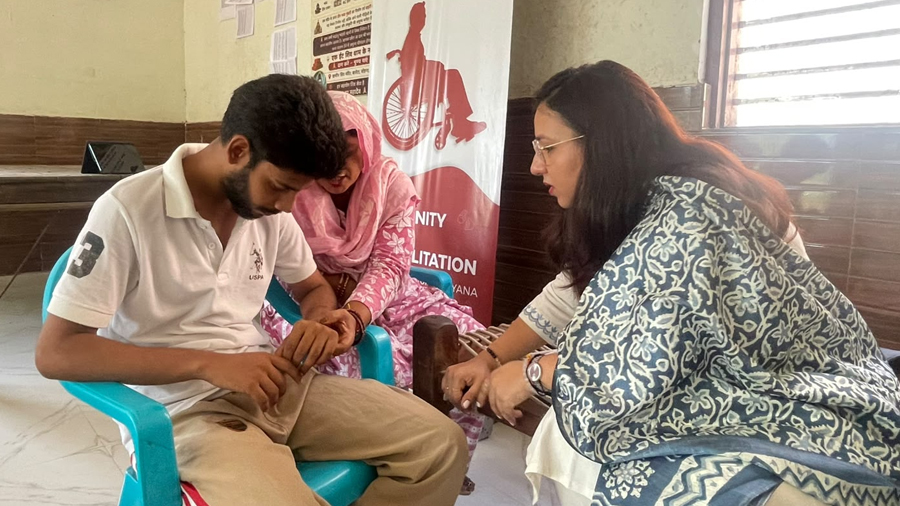
In a Nuh Village, People Living With Mental Illness Finally Got to Speak, and Be Heard
Nine people sat in that room in Barota village, Nuh district, Haryana, each carrying a...
LEARN MORE 91 -11 - 23362735
  director@caritasindia.org


