
 91 -11 - 2336 3390
  director@caritasindia.org
 State Level Consultation in Ranchi Charts the Future of Community Led Development
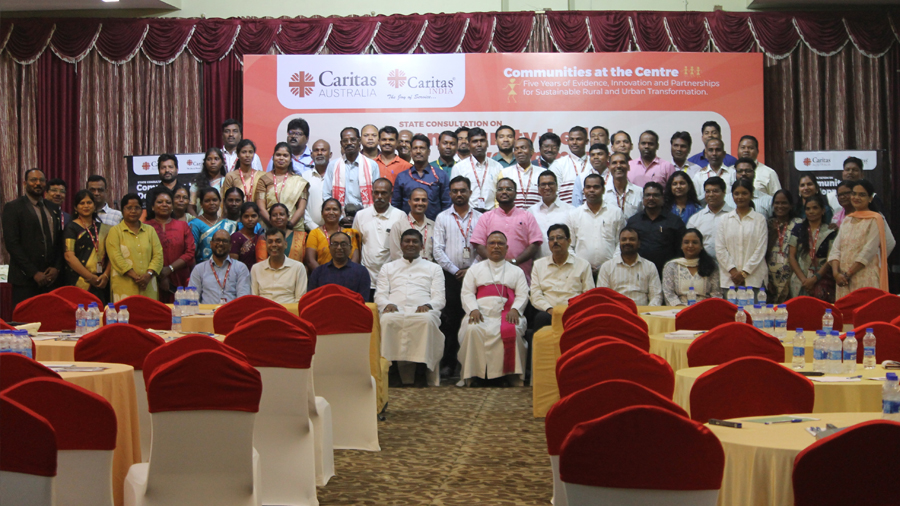
On 2 September 2026 at Ranchi, the usual boundaries between government offices, Church institutions, funding partners and village communities more or less disappeared. More than 80 people, DSSS Directors, community representatives, senior government officials, Church leaders and development partners from across Jharkhand and Chhattisgarh, sat in the same room for a State Consultation marking five years of Caritas India’s Gram Nirman programme.
The gathering was never meant to be a routine review. It was pitched as a state level reckoning, an attempt to pull together evidence, government policy, market linkages and, crucially, community voices from across two states into a single conversation about what community led development should look like next.
Titled “Community Led Development, Communities at the Centre,” the consultation brought state government representatives, NABARD, tribal development bodies and grassroots leaders to the same table, a scale of coordination that organisers said was itself a marker of how far the programme had travelled since it began five years ago.
One story from a small Latehar village called Kita ended up capturing what that state level effort looks like when it reaches the ground. A pond there, once silted up and forgotten, now waters nearly 15 acres of farmland and supports around 25 families, after villagers organised themselves and pushed the renovation through the Gram Sabha and government channels.
“Gram Nirman did not just renovate our pond,” one community member said. “It renovated our thinking.”
A Programme Built on What Communities Already Have
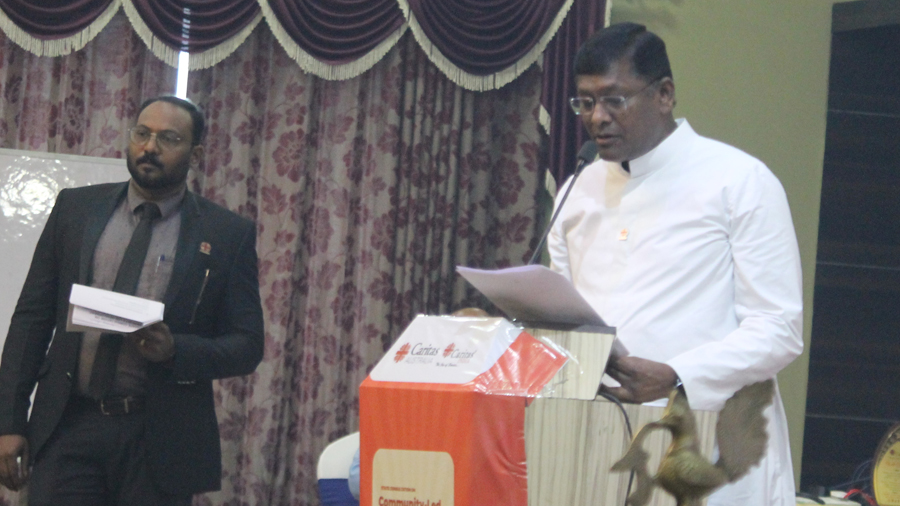
Welcoming participants to the consultation, titled “Community Led Development, Communities at the Centre,” Fr. Jesudass R., Executive Director of Caritas India, said Gram Nirman had never been about delivering services to passive recipients. Communities, he said, had become “leaders, partners and teachers” of their own programme.
At the heart of his address was something the team calls the NIRMAN approach. It stands for Notice the strengths already present, Include every person and every voice, Realise rights and build resilience, Mobilise partnerships and convergence, Accompany communities towards autonomy, and Nurture change that continues beyond the project.
The philosophy behind it is simple but, Fr. Jesudass argued, often overlooked. Development conversations tend to start by asking what a community lacks. He wants them to start by asking what a community already has, knowledge, skills, relationships, natural resources, institutions, traditions and leadership, and then help people use those strengths with confidence.
The Kita pond became his example of what that looks like in practice. Villagers identified the pond themselves, organised themselves, and pushed the process through the Gram Sabha and government channels to get it restored. The irrigation that followed mattered. The confidence that followed mattered more.
“Gram Nirman is not merely the name of a programme,” Fr. Jesudass told the gathering. He described it instead as a way of building relationships, confidence and hope, one that the NIRMAN framework is designed to outlast the project itself.
Voices From Outside, and From the Ground
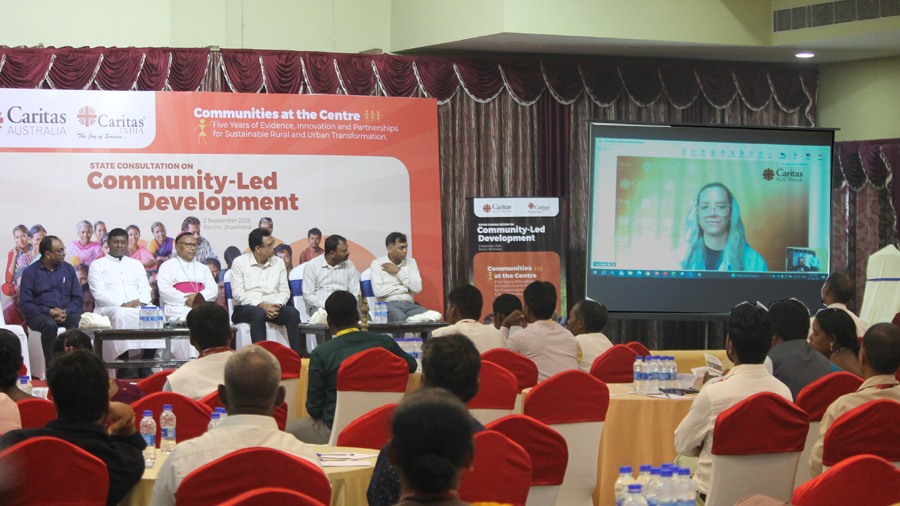
Ms. Paige Wilson, representing Caritas Australia, praised the Gram Nirman team for its five year commitment and spoke about her own visits to project areas, where she said she witnessed real shifts in confidence, leadership and ownership among community members.
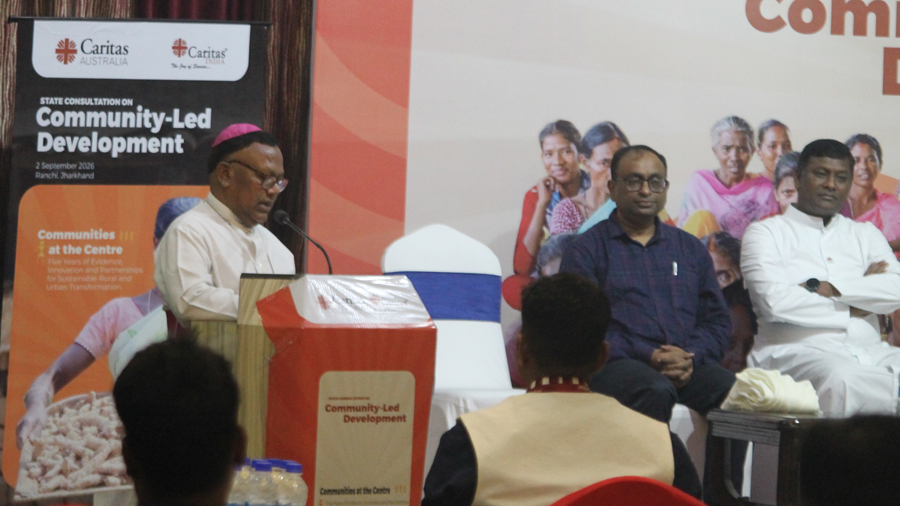
Most Rev. Anand Jojo spoke about the vision of a self reliant, Viksit Bharat, calling on different stakeholders to work together in building stronger, more self sufficient villages. He also unveiled a set of Gram Nirman knowledge products documenting the programme’s five years of learning.
But it was five community representatives from Jharkhand and Chhattisgarh who arguably held the room. Speaking directly about their own experiences, they described how participation and collective action had changed the shape of their daily lives, stories the consultation deliberately placed at its centre rather than treating as a sideshow to the official proceedings.
Alongside the discussions, an exhibition stall gave the day a tangible feel, with indigenous seeds, products made by rural and urban Self Help Groups, and the newly unveiled knowledge products on display. It was less a showcase of what Gram Nirman had given communities and more a display of what communities themselves had built.
The Evidence Behind the Optimism
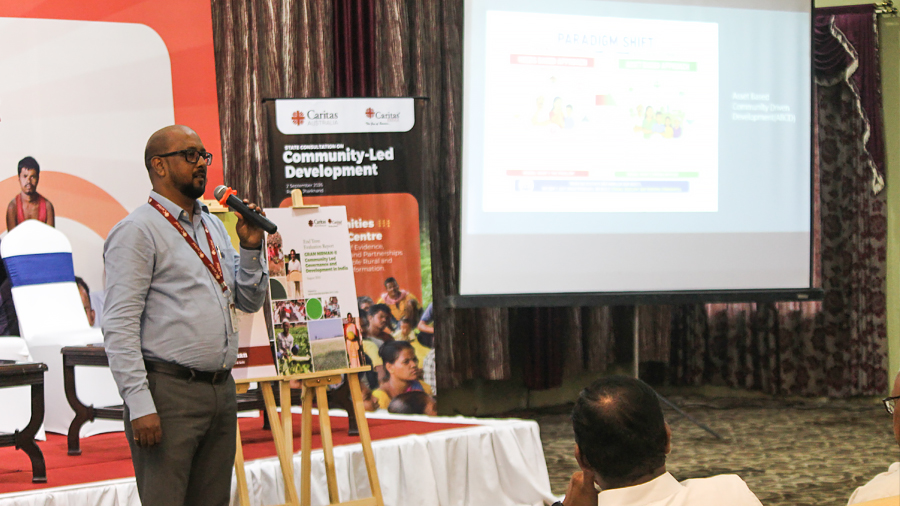
Mr. Nikhil Ritesh Sanga, Programme Lead for Gram Nirman, walked participants through the thinking behind the approach, known formally as Asset Based Community Driven Development. The shift, he explained, is from working for a community to working with one, moving people from receivers of aid to owners of their own development journey.
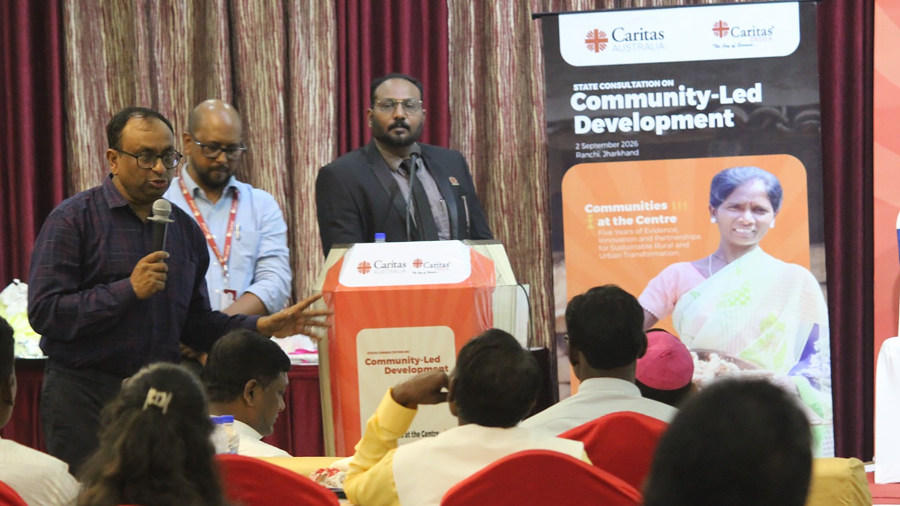
That optimism was tested against evidence. Mr. Pran Ranjan and Dr. Ashwini of Benchmark Private Limited, the independent agency behind the programme’s end term evaluation, presented findings covering both rural and urban components. Their assessment was candid about what comes next, pointing to a need for sharper focus on select value chains and stronger market linkages if livelihood gains are to hold.
The clearest sign of state level buy in came from Mr. Manoj Sinha, Assistant Project Director at the Jharkhand Tribal Development Society, a state government body. He spoke about JTDS interventions spanning 14 Tribal Sub Plan districts across Jharkhand, including work with Particularly Vulnerable Tribal Groups in the Santhal region, and how activated Gram Sabhas and Village Development Funds have helped Farmer Producer Organisations take root at scale, evidence that the community led model was shaping government practice well beyond Caritas India’s own project sites.
Other speakers rounded out the picture of what community led development still needs. Mr. Narendra Prasad of NABARD spoke about strengthening Rural Marts and Haats. Mr. Johnson Topno of the Partnering Hope into Action Foundation argued that Samaj, Sarkar and Bazaar, society, government and market, need to move closer together, with market access remaining the weakest link. Ms. Manna Swati Beck of The Nudge Institute shared learnings from the Phoolo Jhano programme supporting women involved in liquor selling, while Mr. Aman Raj of PREJHA focused on youth employability, and Mr. Chaitanya Ganjhu of CINI Tata Trust spoke about lac cultivation under the NTFP model.
Mr. Suryamani Prasad, Director of CRC, closed the thematic discussions with a pointed reminder: community led development simply does not work without genuine inclusion, and he urged practitioners across the sector to treat it as non negotiable rather than an afterthought.
What Comes Next
The consultation was anchored throughout by Mr. Armstrong Alexander, who kept the day’s many voices moving smoothly from one session to the next, and closed with a vote of thanks from Mr. Prabodh Kujur, who thanked participants, dignitaries and community representatives for making the day count.
What emerged from Ranchi was less a celebration of five completed years than a working note to the future. Communities, speakers agreed again and again, are not the problem development needs to fix. They are the ones best positioned to fix it themselves, given the trust, the tools and the room to lead.
Upcoming News
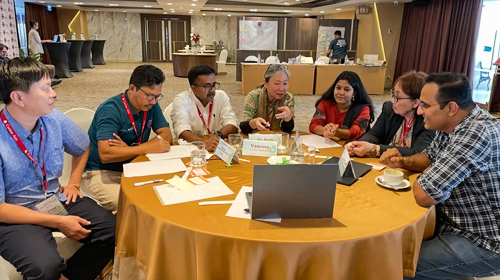
Caritas India Showcases Grassroots Resilience and Women in Leadership at Bangkok Humanitarian Forum
Caritas India placed grassroots climate adaptation and women’s leadership at the centre of regional disaster...
LEARN MORE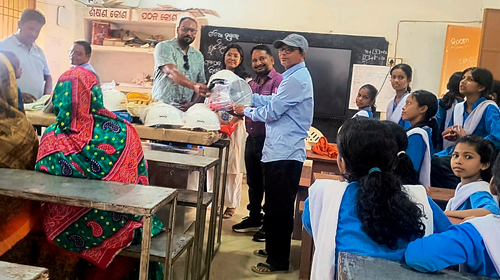
Odisha Schools Armed for Disasters as Caritas India Equips Coastal Classrooms
Caritas India has handed over specialized Comprehensive School Safety Kits to four vulnerable educational institutions...
LEARN MORE
How Family Livelihood Built a Khushaal Bachpan in Bastipara
In Bastipara, a small hamlet of Kevradih village under Sirri Panchayat, Chhattisgarh most families depend...
LEARN MORE 91 -11 - 23362735
  director@caritasindia.org


