
 91 -11 - 2336 3390
  director@caritasindia.org
 Sustainable agriculture for strengthening community livelihood of Vidarbha
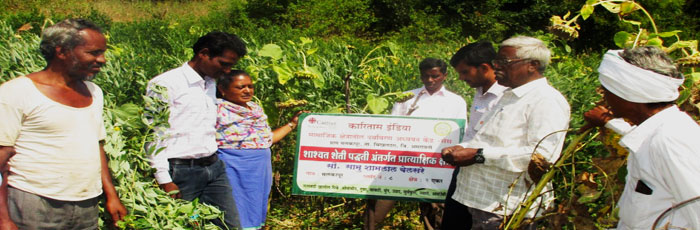
Every 53 minute a farmer is ending his life in Vidarbha. The region became the national importance due to the alarming rate of farmer suicides in last 16 years. Being the most backward region of Maharashtra, the region is struggling with the issues of low agricultural production, lack of proper irrigation facilities, debts, unemployment and lack of industries to support the livelihood.
Government and Civil Society organization taking efforts to control the situation and provide solace to the bereaved farmers. The government has sanctioned various crop insurance schemes, subsidy in seeds, easy loan facilities for the farmers to control the suicides.
Center for Environmental Studies in Social Sector (CESSS) is one such initiative of Caritas India which promotes sustainable Agriculture Regeneration Measures to assist the farming communities in their socio-economic empowerment processes.
CESSS is closely working with all the partners in Vidarbha and other development institutions working in agriculture and development sectors.
Two days training and capacity building of 22 staff of Nagpur Multipurpose Social Service Society, Loksamgraha Social Service Society, Chanda and Jeevan Vikas Sanstha, Amravati was facilitated by CESSS from October 26-27, 2017.
Organized by Western regional Social Service Society, the training cum exposure aimed at strengthening capacities and knowledge of partner’s staff on sustainable agriculture and promotion of community livelihood.
Different theoretical and practical session helped participants to understand Sustainable Agriculture practices, present agrarian crises and impact on small holder farmers. Participants were oriented on climate change and its impact on agriculture, disasters of chemical farming and impact, organic farming and post-harvest technology.
Emphasis was also given to Integrated Pest Management (IPM) and Integrated Nutrient Management (INM) and livelihood. The practical session of IPM gave a hands on experience on preparation and use of various pest repellents like Dashparni, Lamit Ark, Neem Ark, Fish tonic along with trap crop, light trap, yellow sticky trap etc.
During the exposure, participants visited various production trial plots at the village level. They also visited Mini Dal Mill unit, raw materials collection center, and Bio-Manure production Centre’s operated by village youth.
The Sustainable Agriculture Practice models of CESSS trial plots gave the overview of mix cropping system, green manuring method, they learned about farmer friendly birds and enemy birds, developing live fencing and soil & water conservation structures.
CESSS had conducted separate session on accessing existing Government schemes and program to develop various income generation activities and to converge existing livelihood schemes.
The training provided opportunity to work jointly for strengthening the capacities of small farmers and promoting sustainable agriculture practices for the sustainable development of the community.
Upcoming News

Ten Women Turn Papad Making into a Collective Enterprise
In Shiv Parvati Nagar, Indore, ten women have transformed papad making from a familiar household...
LEARN MORE
From Awareness to Action: Strengthening Climate-Resilient Practices through Learning and Innovation
As climate change increasingly affects agriculture, livelihoods and natural resources, the need for practical and...
LEARN MORE
Kerala and Odisha Practitioners Come Together for Workshop on Humanitarian Aid and Disaster Risk Reduction
Disaster risk reduction practitioners from Kerala's Safe Within, Reconnect Wayanad and Vilangad Project travelled to...
LEARN MORE 91 -11 - 2336 3390
  director@caritasindia.org


